
21 Jun 2024
VR technology and educational escape rooms used to train over 600 school children in vital lifesaving skills
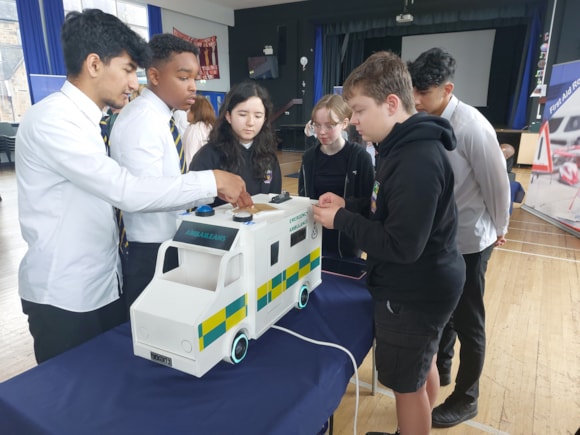
Over 600 high school students have so far been trained in vital lifesaving skills as part of a groundbreaking pilot training programme using innovative technologies such as virtual reality (VR) and educational escape rooms.
The Young Minds Save Lives pilot programme, which is run by the Scottish Ambulance Service and is currently funded by NHS Charities Together, provides young people with critical knowledge and skills on how to respond in a medical emergency and preventative healthcare. The programme also aims to raise awareness about future careers in healthcare and opportunities for volunteering.
Working with staff at Shawlands Academy and Holyrood Secondary School, the pilot training programme has been designed with S3 students to meet the specific needs of the local community whilst providing interest to the young people by using innovative educational tools which are not typically used in a school setting.
The programme, which is delivered to pupils by two local frontline paramedics, covers topics such as CPR where dummies and VR headsets are used, recognising strokes, chest pain and heart attacks, drug and alcohol harm, and excessive bleeding from penetrating wounds such as knives.
The young people took part in educational escape room challenges which tested their knowledge on the topics they had been taught in order to finish the programme.
Reflecting on her experience, Mia Tait, S3 student at Shawlands Academy said: “I’ve really enjoyed taking part in the Young Minds Save Lives pilot programme and have learned loads of new skills. It’s also really increased my confidence, so if I ever came across or was involved in a medical emergency, I’d feel like I’d know what to do now.
“Using a VR headset for our CPR lesson was great fun and when I took it home to show my family, they were keen to have a go too!
“The programme has also given me more of an insight into the work of paramedics and the potential career and volunteering options that are available at the Scottish Ambulance Service when I’m a bit older. I’d never really thought about it before.”
Michael Dickson, Scottish Ambulance Service Chief Executive said: “The Young Minds Saves Lives pilot programme is unique. It’s a co-designed project working with the young people using innovative technology and creative learning methods to educate them on vital skills, and it also focuses on working with the local community to support their needs and issues with the outcome of improving population health, supporting healthcare careers of young people, and wider health and wellbeing.
“The feedback we have received from staff, pupils, parents and the community whilst we’ve been running this pilot project has been absolutely fantastic. The University of Glasgow have undertaken an evaluation of the programme and the next step, subject to securing further investment, is to roll the initiative out across the country in order to train more high school children in vital life-saving skills and preventative healthcare areas, which will benefit additional Scottish communities.”
The pilot programme is supported by Save a Life Scotland, Resus UK, the University of Glasgow, Developing the Young Workforce Glasgow, NHS Education for Scotland, Health Improvement Scotland and Eeek Escape Rooms.
For more information about how you can support the Young Minds Save Lives initiative, contact: sas.ymsl@nhs.scot.
Students pictured today at Shawlands Academy
Contact Information
Scottish Ambulance Press Office
sas.press@nhs.scot
Notes to editors
Notes to editor
The pilot programme ran from August 2023 – June 2024.
- The Scottish Ambulance Service employs over 5000 highly skilled staff.
- We provide an emergency ambulance service to a population of over 5 million people, serving all mainland and island communities.
- Our Patient Transport Service also takes around 1 million patients to and from hospital.
- Each year, we respond to over 1.5 million calls for assistance.
- Over 600,000 of these are emergency and unscheduled incidents.
- We transfer around 90,000 patients between hospitals.
- Our air ambulance service undertakes around 3,500 missions.
- Our ScotSTAR service transfers 2,500 of Scotland's most seriously ill patients each year.
- We are assisted by over 1,200 volunteers, such as our community first responders.

Powered by Onclusive PR Manager © 2026